How Many Grafts Do I Actually Need for a Hair Transplant?
Home / Hair Transplant / How Many Grafts Do I Actually Need for a Hair Transplant?
Posted On : May 28, 2026 | Category : Hair Transplant | Author: Beverly Hills Hair Restoration Team
Summary
- Hair graft needs vary based on hair loss level, donor hair quality, and density goals.
- The Norwood Scale helps estimate graft requirements for different stages of hair loss.
- Natural-looking results depend on proper graft planning and balanced coverage.
- A professional consultation helps determine the right graft count for each patient.
Introduction
One of the biggest concerns patients have before a hair transplant is whether they are choosing the right number of grafts for natural-looking results. Many people worry about spending money on a procedure and still ending up with thin density, poor coverage, or an unnatural hairline. Others fear donor overharvesting, visible scalp thinning, or needing another procedure sooner than expected. The truth is that there is no fixed graft number that works for everyone because every patient has different hair loss patterns, donor density, scalp size, and long-term restoration goals. In this guide, you’ll learn how hair graft counts are estimated, what affects graft requirements, and how proper planning helps create balanced hair transplant results while protecting the donor area for the future.
What Is a Hair Graft?
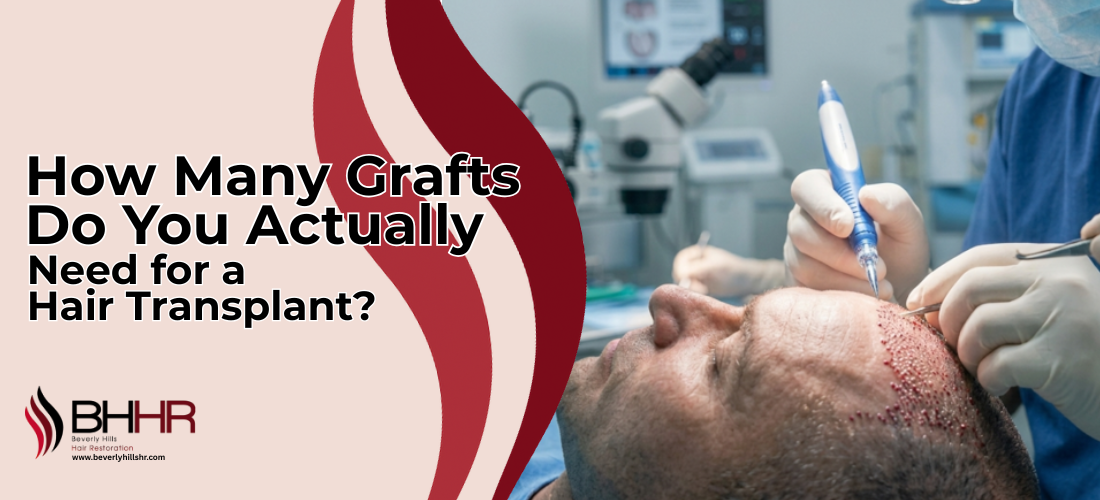
A hair graft is a small group of hair follicles removed from the donor area during a hair transplant procedure. These grafts are carefully placed into thinning or bald areas to improve scalp coverage and hair density.
Each graft can contain one to four hairs, depending on the patient’s natural hair growth pattern. Single-hair grafts are commonly used near the hairline for a softer appearance, while multi-hair grafts help create fuller density in larger areas. Proper graft handling and placement play an important role in achieving natural-looking hair transplant results.
Proper graft survival, angulation, and placement strategy are also important for creating soft hairline density and hairline design.
Factors That Determine Hair Graft Count
The number of grafts needed for a hair transplant can vary significantly from one patient to another. Several factors influence graft planning, including the level of hair loss, scalp coverage area, donor hair quality, and the patient’s desired density goals. Understanding these factors helps create balanced results while preserving healthy donor hair for long-term restoration needs.
- Extent of Hair Loss
Patients with advanced hair loss usually need a higher number of grafts because larger portions of the scalp require coverage. Someone with mild thinning or early recession may only need grafts around the hairline, while extensive baldness often requires treatment across multiple areas. - Size of the Bald Area
The total size of the treatment area plays an important role in graft estimation. Larger bald areas generally require more grafts to create balanced coverage and maintain a soft hairline appearance throughout the scalp. - Desired Hair Density
Some patients prefer softer, lighter density, while others want fuller-looking coverage in highly visible areas like the frontal scalp and hairline. Higher density goals usually require more grafts, but recreating natural teenage-level density is not always realistic or necessary. In many cases, strategic graft placement is used to create the appearance of fuller coverage while preserving donor hair for future restoration needs. - Donor Hair Availability
The quality, strength, and density of the donor area help determine how many grafts can be safely extracted during a hair transplant. Proper donor management is important for achieving natural results while preserving enough hair for future restoration needs.
Once these factors are evaluated, surgeons often use the Norwood Scale to estimate the approximate number of grafts needed for different stages of hair loss.
Hair Graft Estimates by Norwood Scale
The Norwood Scale is the most widely used system to measure the stage of male pattern baldness, ranging from Stage 1 (minimal loss) to Stage 7 (extensive loss). Your stage plays a major role in estimating how many grafts for a hair transplant you will need.
Here is a general breakdown:
|
Norwood Stage |
Hair Loss Level |
Estimated Grafts Needed |
|
Norwood 1 – 2 |
Minimal recession |
500 – 1,000 |
|
Norwood 3 |
Early hairline loss |
1,000 – 1,500 |
|
Norwood 4 |
Moderate thinning |
1,500 – 2,500 |
|
Norwood 5 |
Significant baldness |
2,500 – 3,500 |
|
Norwood 6 – 7 |
Extensive hair loss |
3,500 – 5,000+ |
Important: These are general estimates only. Your actual graft count depends on your donor density, scalp laxity, hair characteristics, and personal goals. Always get a professional evaluation before making any decisions.
What Results Can You Expect from Different Graft Numbers?
The results of a hair transplant can vary depending on the number of grafts used, the size of the treatment area, and the patient’s hair characteristics. Smaller graft sessions are often used for limited correction, while higher graft counts may provide broader scalp coverage and improved density in advanced hair loss cases.
- 1000–1500 Grafts
This graft range is commonly used for minor hairline correction, temple recession, or small thinning areas. Patients with early hair loss may achieve noticeable improvement in facial framing and overall hairline appearance without requiring large scalp coverage. - 2000–3000 Grafts
Patients with moderate hair loss often use this range to improve density across the frontal scalp and larger thinning areas. It can provide stronger coverage while maintaining a natural transition between transplanted and existing hair. - 3500–5000+ Grafts
Higher graft counts are generally recommended for advanced hair loss involving the hairline, mid-scalp, and crown area. These procedures are designed to improve overall scalp coverage in patients with larger bald areas and more extensive thinning.
Final hair transplant results can vary depending on healing response, hair characteristics, scalp contrast, and ongoing hair loss progression.
How Dr. John Kahen Customizes Hair Graft Planning for Natural Results
Dr. John Kahen is known for his experience in advanced hair restoration procedures, including Smart FUE, Smart FUT, corrective hair transplants, and natural hairline design. He has also been a member of the International Society of Hair Restoration Surgery (ISHRS) since 2007, reflecting his continued involvement in modern hair restoration techniques and patient-focused treatment planning.
Before recommending a graft count, he carefully evaluates the patient’s stage of hair loss, donor strength, scalp condition, facial structure, and long-term restoration goals. His approach focuses on balanced density, strategic graft placement, and preserving healthy donor hair for the future. Rather than using a one-size-fits-all method, each treatment plan is customized to create balanced -looking hair transplant results that continue to look balanced over time.
Conclusion
There is no fixed number of grafts that work for every patient because every hair loss pattern, scalp condition, and density goal is different. The best hair transplant results come from a customized treatment plan designed around the patient’s individual needs rather than simply using a higher graft count.
A professional consultation can help determine the appropriate graft count based on your hair loss pattern, donor hair quality, and long-term goals. Schedule a free consultation with Dr. John Kahen today to receive a personalized graft assessment and treatment plan for natural-looking, undetectable results.
Frequently Asked Questions
Can you Get Too Many Grafts in One Procedure?
Yes, it is possible to transplant too many grafts in one procedure if the donor area cannot safely support the extraction. Overharvesting may affect donor density and impact future hair transplant options. Experienced surgeons carefully plan graft counts to maintain balanced results and protect long-term hair health.
How many grafts are needed for a full head of hair?
The number of grafts needed depends on the amount of hair loss, scalp size, donor hair availability, and desired density. Patients with advanced hair loss may require multiple sessions to achieve balanced coverage and natural-looking results.
How many hairs can one hair graft contain?
Most hair grafts contain between 1 and 4 hairs, depending on the patient’s natural hair growth pattern. Single-hair grafts are often used near the hairline for a softer appearance, while multi-hair grafts help improve density in larger areas.
Can I calculate my graft count online?
Online graft calculators can provide a rough estimate based on your level of hair loss, but they cannot fully evaluate donor density, scalp condition, or long-term hair restoration needs. An expert assessment is the most accurate way to determine the right graft count for natural-looking results.
Why Do More Grafts Not Always Mean Better Results?
Using more grafts does not always guarantee better hair transplant results. Overharvesting the donor area can affect donor density and may lead to an unnatural appearance. Natural-looking results depend more on proper graft distribution, hairline design, scalp coverage, and long-term planning rather than simply using the highest number of grafts possible.