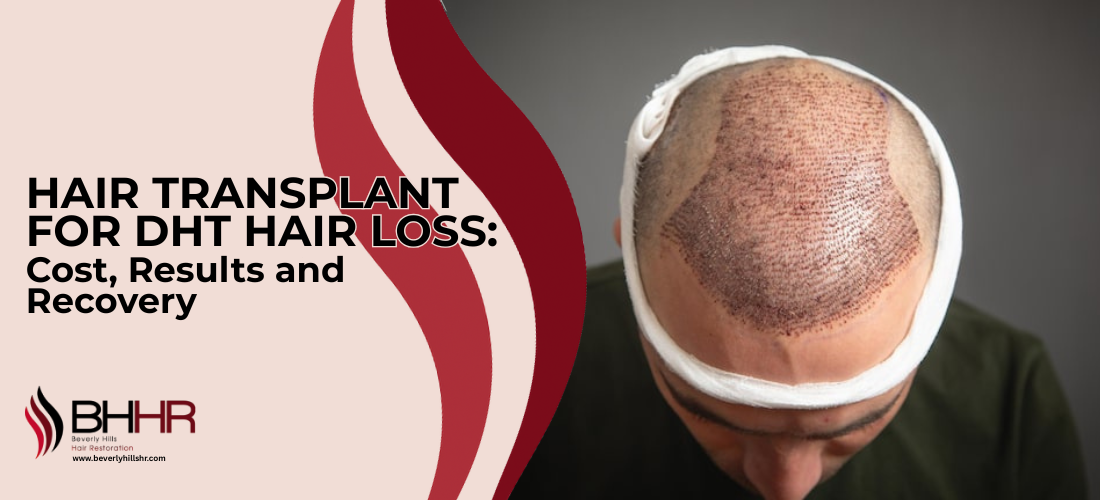
Hair Transplant for DHT Hair Loss: Cost, Results, and Recovery
Home / Hair Transplant / Hair Transplant for DHT Hair Loss: Cost, Results, and Recovery
Posted On : July 11, 2026 | Category : Hair Transplant | Author: Beverly Hills Hair Restoration Team
Summary
- This blog explains how DHT causes hair thinning, receding hairlines, and crown hair loss.
- How a hair transplant can help restore hair in areas where DHT has caused permanent hair loss.
- Compare FUE, FUT, and Smart PRP so readers can understand how each option works.
- The main factors that affect hair transplant cost, expected results, growth timeline, and recovery process.
- Highlights why expert planning, aftercare, and long-term hair preservation are important for natural-looking results.
Introduction
DHT hair loss is one of the most common reasons people notice thinning hair, a receding hairline, or hair loss around the crown. It happens slowly, so many people do not realize how much hair they have lost until the thinning becomes more visible. At first, shampoos, oils, or hair products may feel like the easiest option, but they often cannot bring back hair once the follicles have stopped growing.
A hair transplant may help restore hair in areas where permanent hair loss has already happened. The procedure uses healthy hair follicles from the donor area, usually the back or sides of the scalp, and places them into thinning or bald areas. These hairs are usually more resistant to DHT, which is why they can continue growing after transplantation.
In this guide, you will learn how a hair transplant works for DHT-related hair loss, what affects the cost, what kind of results you can expect, and how recovery usually looks. You will also understand why proper planning, hair quality, and expert evaluation matter before choosing treatment.
What Is DHT (Dihydrotestosterone)?
DHT (Dihydrotestosterone) is a hormone made from testosterone with the help of an enzyme called 5-alpha reductase. It plays an important role in normal growth and development, but it can also be one of the main causes of hair loss in people who are genetically sensitive to it.
When DHT affects hair follicles on the front and top of the scalp, the follicles gradually shrink and produce thinner hair. This process causes hair to grow thinner, weaker, and shorter with each growth cycle. Over time, some follicles stop producing new hair completely, leading to a receding hairline, thinning at the crown, or more noticeable bald areas.
Not everyone is affected by DHT in the same way. Genetics play the biggest role in determining how sensitive your hair follicles are to this hormone, which is why some people experience significant hair loss while others do not.
Causes and Signs of DHT Hair Loss
This hair loss usually develops gradually, making it easy to overlook the early changes. Understanding what contributes to this type of hair loss and recognizing the first warning signs can help you seek treatment before the condition progresses. Below are the most common causes and symptoms associated with DHT-related hair loss.
Common Causes of DHT Hair Loss
- Genetics and Receptor Sensitivity: Hereditary factors determine how sensitive your hair follicles are to DHT. In those predisposed to pattern baldness, DHT binds to receptors in susceptible follicles (typically at the temples and crown), initiating a shrinking process called miniaturization.
- The 5-Alpha Reductase Enzyme: Approximately 10% of circulating testosterone is converted into DHT daily by the 5-alpha reductase enzyme. An overabundance of this enzyme or heightened activity in the scalp leads to increased localized DHT levels.
- Hormonal Imbalances: While primarily recognized as a male hormone, both men and women produce DHT. Hormonal shifts caused by stress, polycystic ovary syndrome (PCOS), menopause, or anabolic steroid use can trigger or accelerate this process.
- Advancing Age: As people age, hormonal balances shift, often leading to a buildup of DHT's effects and a decrease in the hair's natural growth cycle.
Common Signs of DHT Hair Loss
- A receding hairline, especially around the temples.
- Thinning at the crown or top of the scalp.
- Hair that becomes thin and less dense over time.
- Increased hair shedding during brushing or washing.
- More scalp is becoming visible due to reduced hair density.
Recognizing these causes and signs early can help you explore treatment options before hair loss becomes more advanced.
Can a Hair Transplant Treat DHT Hair Loss?
Yes, a hair transplant can restore hair in areas where follicles have stopped growing because of DHT. During the procedure, healthy hair follicles are taken from the back or sides of the scalp, known as the donor area, and transplanted into thinning or bald areas. These donor follicles are usually more resistant to DHT, allowing them to continue growing in their new location.
However, a hair transplant does not stop DHT from affecting your existing, non-transplanted hair. If hair loss continues, untreated areas may become thinner over time. For this reason, your specialist may recommend a personalized treatment plan that includes ongoing hair loss management alongside your transplant to help maintain long-term results.
Treatment Options for DHT Hair Loss: Smart FUE vs Smart FUT vs Smart PRP
Not every case of hair loss calls for the same solution. Depending on how advanced your thinning is and how much donor hair you have available, your specialist may recommend Follicular Unit Extraction (FUE), Follicular Unit Transplantation (FUT), or Smart PRP (Platelet-Rich Plasma) therapy either on its own or alongside a transplant. FUE and FUT both restore hair by relocating healthy follicles, while Smart PRP works differently, using your own blood's growth factors to strengthen existing hair rather than replace what's already been lost. The table below breaks down how these options compare.
|
Feature |
Smart FUE Hair Transplant |
Smart FUT Hair Transplant |
Smart PRP Treatment |
|
Technique |
Individual follicles are extracted and implanted |
A strip of scalp is removed to collect grafts |
Growth factors are injected into the scalp |
|
Purpose |
Restores lost hair |
Restores lost hair |
Supports existing hair and improves scalp health |
|
Scarring |
Minimal dot-like scars |
Linear scar |
No surgical scar |
|
Recovery Time |
7–10 days |
10–14 days |
Minimal downtime |
|
Graft Yield |
High |
Very high |
No grafts used |
|
Best For |
Small to medium hair restoration |
Larger restoration sessions |
Early thinning or post-transplant support |
|
Cost |
Higher than FUT |
Lower per graft |
Usually lower than transplant |
Hair Transplant Cost for DHT Hair Loss
The cost of a hair transplant varies from person to person because every treatment plan is different. Instead of a fixed price, the total cost depends on your level of hair loss, the number of grafts needed, and the approach recommended by your surgeon.
Several factors can affect the cost, including:
- Number of grafts: Larger treatment areas require more grafts, which can increase the overall cost.
- Degree of hair loss: Advanced hair loss often needs a more extensive procedure than early-stage thinning.
- Technique used: Procedures such as Smart FUE or FUT may have different costs depending on the treatment plan.
- Surgeon experience: An experienced hair restoration specialist may charge more for their expertise and personalized approach.
- Clinic location: Treatment costs can vary depending on the clinic and its location.
The specialist will evaluate your hair loss, examine your donor area, discuss your goals, and provide a customized treatment plan with personalized pricing.
What Results Can You Expect?
A hair transplant for DHT hair loss delivers gradual results, so patience is important. Newly transplanted hair grows in stages, and it can take up to 12 to 18 months to see the full outcome. The exact timeline varies from person to person based on healing, hair growth cycles, and the number of grafts transplanted.
|
Timeframe |
What to Expect |
|
2-4 Weeks |
The transplanted hairs may shed during the first few weeks as part of the natural healing and growth cycle. The healthy follicles remain in place and can begin producing new hair in the following months. |
|
3-4 Months |
New hair begins to grow. The hairs are usually thin, soft, and lighter at first. |
|
6-9 Months |
Hair becomes thicker, denser, and more noticeable as the transplanted follicles continue to mature. |
|
12-18 Months |
Most patients see their final results, with improved density, natural texture, and a more complete appearance. |
Following your surgeon's aftercare instructions and attending follow-up appointments can help support healthy healing and the best possible outcome.
Hair Transplant Recovery After DHT Hair Loss
Healing after a hair transplant happens in stages, so it helps to know what's normal. Expect mild swelling and scabs in the first few days, followed by light shedding around month one; this is shock loss, not failure. Since hair loss can still affect nearby native hair, keep up your DHT blocker routine during recovery to protect it while the new grafts settle in.
|
Recovery Stage |
What Happens |
Simple Care Tips |
|
Day 1–3 |
Mild swelling and scabs form |
Sleep with your head raised, don't touch your scalp |
|
Day 4–7 |
Scabs start to fall off |
Rinse gently with saline, nothing rough |
|
Week 2 |
Back to normal daily routine |
Skip the gym and heavy sweating for now |
|
Month 1–3 |
Some shedding happens (shock loss) |
Totally normal try not to worry |
|
Month 4–12 |
Fresh hair starts growing in |
Keep up your DHT management routine |
Why Choose Beverly Hills Hair Restoration for DHT Hair Loss?
Choosing the right clinic matters as much as choosing the right treatment. At Beverly Hills Hair Restoration, conveniently located near Rodeo Drive in Beverly Hills, Dr. John Kahen leads every procedure with years of hands-on experience treating DHT hair loss in men and women. Instead of using a one-size-fits-all approach, he builds each treatment plan around the patient’s hair loss pattern, goals, and long-term DHT management needs. Using advanced FUE techniques, Dr. Kahen designs natural-looking hairlines that blend smoothly with existing hair, so the results look like natural growth rather than an obvious transplant. With many successful procedures behind him, patients receive more than surgery; they receive experienced guidance at every stage of the process.
- Experienced surgeon: Dr. John Kahen, M.D. an ISHRS member since 2007, personally performs procedures, backed by thousands of successful cases
- Personalized plans: Treatment tailored to your hair loss stage, goals, and DHT sensitivity
- Natural hairline design: Careful graft placement for an undetectable, natural look
- Advanced FUE techniques: Precise extraction with minimal scarring and faster healing
- Comprehensive aftercare: Ongoing support and DHT management guidance through recovery and beyond
Conclusion
DHT hair loss is the most common cause of male and female pattern hair loss, leading to gradual thinning and permanent hair loss over time. While a hair transplant can restore hair in areas where follicles have stopped growing, it does not stop the underlying hormonal process that may continue to affect your existing hair.
For the best long-term outcome, a hair transplant should be combined with a thorough evaluation and a personalized hair preservation plan. This approach helps protect your existing hair while creating natural-looking, lasting results that match your hair restoration goals.
If you're considering a hair transplant, schedule a free consultation at Beverly Hills Hair Restoration, conveniently located near Rodeo Drive in Beverly Hills. Dr. John Kahen and his team will assess your hair loss, discuss your treatment options, and create a personalized plan to help you achieve fuller, natural-looking hair with confidence.
FAQS
How do I know if I'm a good candidate for a hair transplant for DHT hair loss?
You may be a good candidate if your hair loss has become stable, you have healthy donor hair, and your thinning is caused by DHT. A consultation with a hair restoration specialist can determine whether a hair transplant or another treatment is the right option for your condition.
Are transplanted hairs resistant to DHT?
Yes, transplanted hair follicles are typically taken from the back and sides of the scalp, where they are naturally more resistant to DHT. Because of this, they usually continue to grow after being transplanted into thinning or bald areas. While transplanted hair is generally less affected by DHT, your existing, non-transplanted hair can still thin over time, which is why long-term hair preservation and regular follow-up care are important.
Is FUE or FUT better for DHT hair loss?
Both FUE and FUT can effectively treat DHT hair loss, and the best option depends on your individual needs. FUE is often preferred for its minimal scarring, faster recovery, and ability to create natural-looking results. FUT may be recommended when a larger number of grafts is needed. During your consultation, your hair restoration specialist will evaluate your hair loss pattern, donor area, and goals to recommend the most suitable technique.
Can women with DHT hair loss get a hair transplant?
Yes. Women experiencing DHT-related hair loss may be candidates for a hair transplant if they have sufficient donor hair and meet the appropriate treatment criteria. A personalized evaluation helps determine the best approach.