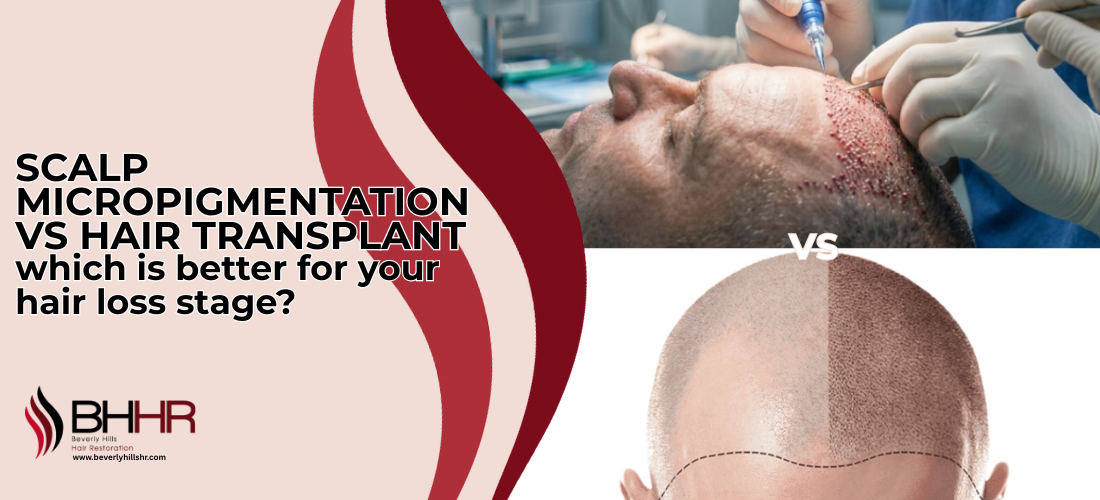
Scalp micropigmentation vs. hair transplant — which is better for your hair loss stage?
Home / Hair Transplant / Scalp micropigmentation vs. hair transplant — which is better for your hair loss stage?
Posted On : June 23, 2026 | Category : Hair Transplant | Author: Beverly Hills Hair Restoration Team
Quick Summary
- Wondering whether scalp micropigmentation or a hair transplant is right for you, according to your hair loss stage?
- Explains the key differences between SMP and hair transplants in simple terms.
- Helps identify which treatment may be suitable for early, moderate, or advanced hair loss.
- Discusses when combining SMP and a hair transplant may be beneficial.
- Helps readers make informed hair restoration decisions with professional guidance.
Introduction
Hair loss can be confusing when you are trying to choose the right treatment. Some people want a fuller-looking scalp without surgery, while others want real hair growth that can be cut, styled, and maintained naturally. This is where the comparison between scalp micropigmentation and a hair transplant becomes important.
Both treatments can improve the appearance of hair loss, but they are not the same. Scalp micropigmentation creates the look of thicker hair using tiny pigment dots on the scalp, while a hair transplant moves healthy hair follicles to thinning or bald areas. The better choice depends on your hair loss stage, donor hair availability, lifestyle, and long-term goals. This guide will help you understand which option may be better for your current stage of hair loss.
Understanding SMP and Hair Transplant
Scalp micropigmentation (SMP) and hair transplant are both hair restoration options, but they work in different ways. SMP is a non-surgical solution that uses tiny pigment deposits on the scalp to create the appearance of natural hair follicles. It helps reduce the contrast between the scalp and existing hair, making thinning areas look denser. However, SMP does not grow new hair.
A hair transplant is a surgical procedure that moves healthy hair follicles from the donor area, usually the back or sides of the scalp, to thinning or bald areas. Once the transplanted follicles heal, they can grow real hair that can be washed, cut, and styled naturally.
SMP may be suitable for people who want a fuller-looking scalp, a shaved-head appearance, or scar coverage without surgery. A hair transplant may be better for people who want real hair growth, improved coverage, and long-term restoration using their own natural hair.
SMP vs Hair Transplant Side-by-Side Comparison
Understanding the difference between SMP and a hair transplant can help you choose the right option for your hair loss stage. SMP creates the look of a fuller scalp with pigment, while a hair transplant restores real hair growth using healthy follicles. Comparing their cost, results, and suitability can help you decide which treatment fits your needs best.
|
Factors |
SMP |
Hair Transplant |
|
Goal |
Makes thinning areas look fuller |
Restores real hair growth |
|
Surgery Required |
No |
Yes |
|
Best For |
Thin-looking scalp, shaved style, scars |
Receding hairline, bald spots, thinning |
|
Type of Result |
Creates the look of density |
Grows your own hair |
|
New Hair Growth |
No |
Yes |
|
Downtime |
Usually minimal |
Needs more healing time |
|
Maintenance |
May need touch-ups later |
Needs regular hair care |
|
Cost |
Lower |
Higher |
|
Best hair Loss Stage |
Early thinning |
Moderate hair loss with good donor hair |
|
Best if You Want |
A fuller look without surgery |
Real hair that grows |
How to Determine Your Hair Loss Stage
Understanding your stage of hair loss can help you choose a treatment that matches your needs and expectations. While everyone experiences hair loss differently, most cases fall into three general stages: early thinning, moderate hair loss, and advanced hair loss.
Early Hair Thinning
Early hair loss often begins gradually. You may notice a slightly receding hairline, reduced volume, increased shedding, or more scalp visibility under bright lighting. At this stage, the goal is usually to improve the appearance of density and address changes before hair loss becomes more noticeable.
Moderate Hair Loss
Moderate hair loss is typically easier to see. Common signs include a deeper receding hairline, thinning at the crown, wider part lines, or visible scalp in certain areas. Many people at this stage start looking for solutions that can improve coverage and restore a more balanced appearance.
Advanced Hair Loss
Advanced hair loss involves larger areas of thinning or baldness. Hair loss may affect the hairline, crown, or multiple regions of the scalp. At this stage, treatment decisions often depend on factors such as donor hair availability, the extent of hair loss, and long-term restoration goals.
Can You Combine SMP and a Hair Transplant?
Yes, some patients choose to combine scalp micropigmentation and a hair transplant because the two treatments can complement each other. While a hair transplant restores real hair growth, SMP can help improve the appearance of density in areas where additional fullness is desired.
One common reason for combining both treatments is to enhance the visual density of a hair transplant. Even after successful hair restoration, some patients may still notice mild scalp visibility, especially under bright lighting or in areas with finer hair. SMP can help reduce this contrast and create the appearance of thicker coverage.
Some people also use SMP to improve the overall look of the scalp when donor hair is limited. By combining real hair growth with the visual density created by SMP, patients may achieve a fuller and more balanced appearance without requiring additional grafts.
Why People Trust Beverly Hills Hair Restoration for Hair Loss Solutions
People trust Beverly Hills Hair Restoration because the clinic takes a careful and personalized approach to hair loss treatment. Led by Dr. John Kahen, who has been a member of the International Society of Hair Restoration Surgery (ISHRS) since 2007 and has extensive experience evaluating different stages of hair loss. His approach focuses on recommending treatment options based on each patient's hair characteristics, donor supply, scalp condition, and long-term restoration goals.
The clinic offers both hair transplant procedures and non-surgical options such as scalp micropigmentation, helping patients understand the benefits and limits of each choice. With experience in FUE and FUT techniques, natural hairline planning, realistic density goals, and ongoing patient guidance, Beverly Hills Hair Restoration focuses on safe, informed, and natural-looking hair restoration decisions.
Conclusion: Finding the Right Hair Loss Solution for Your Stage of Hair Loss
The best hair restoration option often depends on how advanced your hair loss has become and the type of result you hope to achieve. People with early thinning may benefit from non-surgical treatments or scalp micropigmentation, while those experiencing more significant hair loss and who have sufficient donor hair may be candidates for a hair transplant. In some cases, combining different treatments can help create a fuller, more natural-looking result.
Because every person’s hair loss pattern, donor hair availability, lifestyle, and long-term expectations are different, there is no single solution that works for everyone. A professional evaluation can help determine the most appropriate approach based on your current condition and future hair restoration goals. At Beverly Hills Hair Restoration, Dr. John Kahen provides personalized hair restoration assessments to help patients understand their options and develop a treatment plan tailored to their needs. If you are considering hair restoration, scheduling a consultation is the best way to explore the solution that aligns with your goals and expectations.
FAQs
Is scalp micropigmentation better than a hair transplant?
Neither treatment is universally better. Scalp micropigmentation creates the appearance of fuller hair without surgery, while a hair transplant restores real hair growth. The better option depends on your hair loss stage, donor hair availability, and restoration goals.
Can advanced baldness be treated with a hair transplant?
In many cases, advanced baldness can be treated with a hair transplant if there is enough healthy donor hair available. However, the extent of coverage and density that can be achieved depends on the amount of donor hair and the severity of hair loss.
Can Women Get Scalp Micropigmentation?
Yes, women can get scalp micropigmentation. It is often used to reduce the appearance of thinning hair, wider part lines, and visible scalp areas by creating the look of greater hair density without surgery.
Which Looks More Natural, SMP or a Hair Transplant?
Both can look natural when performed properly, but they achieve different results. A hair transplant provides real growing hair, while SMP creates the appearance of hair follicles and adds density on the scalp.