Can a Bad Hair Transplant Be Fixed? Signs, Causes & Solutions
Home / Hair Transplant / Can a Bad Hair Transplant Be Fixed? Signs, Causes & Solutions
Posted On : September 08, 2026 | Category : Hair Transplant | Author: Beverly Hills Hair Restoration Team
Quick Answer
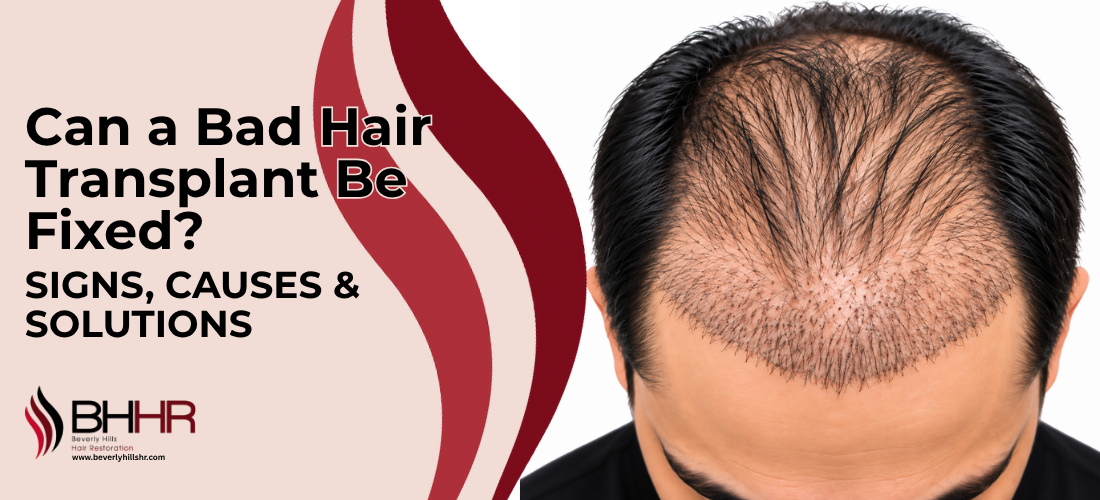
If your hair transplant does not look the way you expected, there may still be ways to improve the results. An uneven hairline, patchy growth, low density, or visible scars can often be addressed with a hair transplant repair. The right option depends on what went wrong, how well the existing grafts have grown, and how much healthy donor hair is available.
Introduction
A hair transplant is something most people choose with the hope of getting fuller, natural-looking hair. But what happens when the results do not look the way you expected? Maybe enough time has passed and you are still unsure about the growth, or something about the final appearance simply does not feel right. At that point, it is natural to wonder whether the transplant has failed and, more importantly, whether anything can be done about it.
The good news is that an unsatisfactory result does not always mean you are out of options. It is also important not to judge a transplant too early, as hair growth takes time and some changes are a normal part of recovery. In this guide, we will help you understand when there may actually be a problem, why it can happen, and what you should know if you are considering hair transplant repair.
Signs Your Hair Transplant May Have Gone Wrong
Some changes are normal during early recovery, but problems that continue beyond the expected healing period may be a sign that the transplant has not gone as planned.
- Poor or Uneven Hair Growth: Some areas may grow well while others remain thin or show very little growth.
- Unnatural-Looking Hairline: The hairline may look too straight, too low, uneven, or out of place with your natural features.
- Patchy or Low Hair Density: Visible gaps or thin areas can make the transplanted hair look uneven or incomplete.
- Incorrect Hair Direction or Angle: Hair growing in the wrong direction can make the transplant look unnatural.
- Visible or Excessive Scarring: Noticeable scars in the donor or transplanted area may remain after healing.
- Overharvested Donor Area: Taking too many grafts can leave the donor area looking thin or patchy.
- Persistent Redness, Pain, or Other Concerning Symptoms: Ongoing pain, redness, swelling, or discharge should be checked by a medical professional.
What Causes a Bad Hair Transplant?
A hair transplant can produce poor results for several reasons, from the way the procedure is planned to how the grafts are handled and cared for afterward. Some of the most common causes include:
- Poor Surgical Planning: A treatment plan that does not properly consider hair loss, donor supply, and future hair loss can affect the long-term result.
- Inexperienced or Unqualified Provider: Lack of experience can lead to mistakes in graft extraction, placement, hairline planning, or donor area management.
- Poor Graft Handling: Hair follicles can become damaged if they are not handled or stored properly between extraction and placement.
- Incorrect Graft Placement: Grafts placed at the wrong depth, angle, or direction may grow unevenly or look unnatural.
- Overharvesting the Donor Area: Removing too many grafts can leave the donor area noticeably thin and limit options for future procedures.
- Poor Hairline Design: A hairline that is too low, straight, or poorly shaped may not blend naturally with the face and existing hair.
- Poor Aftercare: Scratching the scalp, disturbing the grafts, or not following recovery instructions may affect healing and early graft survival.
- Individual Hair and Scalp Factors: Hair quality, scalp condition, ongoing hair loss, and available donor hair can all influence the final result.
When Can You Tell If a Hair Transplant Has Failed?
You usually cannot tell whether a hair transplant has failed during the first few months. Temporary shedding is common after the procedure, and new hair often begins to appear around 3 to 4 months. Early growth may also look thin or uneven, so this stage is generally too soon to judge the final result.
More visible growth usually develops between 6 and 9 months, while the full result may take around 12 months or longer. If there is still very little growth, significant patchiness, or an unnatural appearance after this period, the transplant may need to be evaluated. A hair restoration specialist can check the transplanted area, graft growth, and donor area to determine whether the procedure has failed or the hair simply needs more time to mature.
Can Previous Hair Transplant Results Be Improved?
Not every disappointing hair transplant result is permanent. In many cases, the appearance can be improved, but the right repair approach depends on what went wrong and how much healthy donor hair is still available.
An unnatural hairline may be reshaped, while patchy growth or low density may be improved with additional grafts. Visible scars and poorly placed grafts may also be corrected depending on the condition of the scalp. In some cases, a second hair transplant may be needed to improve coverage and create a more natural look.
Before planning any repair, the scalp, donor area, and existing grafts should be carefully evaluated. This helps determine what can realistically be improved and which treatment option is most suitable.
How Dr. John Kahen Repairs Failed Hair Transplants
When a previous hair transplant does not look natural or has not grown as expected, Dr. John Kahen, MD, at Beverly Hills Hair Restoration starts by finding out what went wrong. He looks at the hairline, transplanted area, donor area, existing graft growth, and any visible scarring before planning the next step.
Depending on the problem, the repair may focus on reshaping an unnatural hairline, adding density to thin or patchy areas, or correcting poorly placed grafts. When another surgical procedure is suitable, Dr. Kahen may use Smart FUE® or Smart FUT®, depending on the patient’s donor area, previous surgery, and repair needs.
Smart FUE® removes individual follicular units, while Smart FUT® uses a donor strip to collect grafts for transplantation. The choice between them depends on how much healthy donor hair remains and what type of correction is needed. The goal is to use the available grafts carefully and create a more natural, balanced result.
How Long Should You Wait Before Getting a Hair Transplant Correction?
Seeing a result you are unhappy with may make you want to fix it right away. However, a hair transplant can look very different during the early stages than it will once the hair has fully grown. Giving the scalp and transplanted follicles enough time to recover is important before deciding on another procedure.
New hair often begins growing around 3 to 4 months, with more noticeable changes between 6 and 9 months. The result can continue to develop for around 12 months or longer.
Once enough time has passed, a surgeon can better see which grafts have grown, where density is lacking, and whether the donor area has healed well. The timing of a correction should therefore be based on your healing, hair growth, and the specific problem that needs to be repaired.
Hair Transplant Repair: What to Consider Before Treatment
A second hair transplant needs even more careful planning than the first. The donor area has already been used, some grafts may still be growing, and the scalp may have scarring from the previous procedure. For this reason, the focus should be on understanding what can safely and realistically be improved.
Before moving forward with hair transplant repair, consider:
- Remaining Donor Hair: The surgeon needs to check whether enough healthy donor follicles are available for the correction.
- Existing Hair Growth: Previous grafts should be evaluated to see which areas actually need more coverage or correction.
- Scalp and Scarring: Any scar tissue or changes from the first procedure can affect how the repair is planned.
- Type of Correction Needed: Fixing an unnatural hairline may require a different approach than improving low density or patchy growth.
- Future Hair Loss: Ongoing hair loss should be considered so the repaired result continues to look balanced over time.
- Realistic Expectations: The goal should be based on what can reasonably be achieved with the remaining donor hair and current scalp condition.
FAQs
Can a bad hair transplant be completely fixed?
Some bad hair transplant results can be greatly improved, but complete correction is not always possible. It depends on the problem, existing grafts, scalp condition, scarring, and how much healthy donor hair remains.
Can an unnatural hairline be corrected after a hair transplant?
Yes, an unnatural hairline can often be improved. Depending on the original result, repair may involve adding carefully placed grafts, reshaping the hairline, or addressing poorly positioned grafts to create a more natural appearance.
Can an overharvested donor area be repaired?
An overharvested donor area can be difficult to repair because removed follicles do not grow back in the donor area. Depending on the remaining hair and degree of thinning, a specialist can determine whether further treatment may improve its appearance.
Will a second hair transplant damage existing grafts?
A properly planned second hair transplant is performed with existing grafts in mind. The surgeon needs to carefully assess their location, growth, and available space before placing additional grafts to reduce the risk of damaging healthy follicles.
How long does it take to see results after a corrective hair transplant?
Corrective hair transplant results develop gradually. New growth may begin around 3 to 4 months, become more noticeable between 6 and 9 months, and continue to improve for around 12 months or longer.