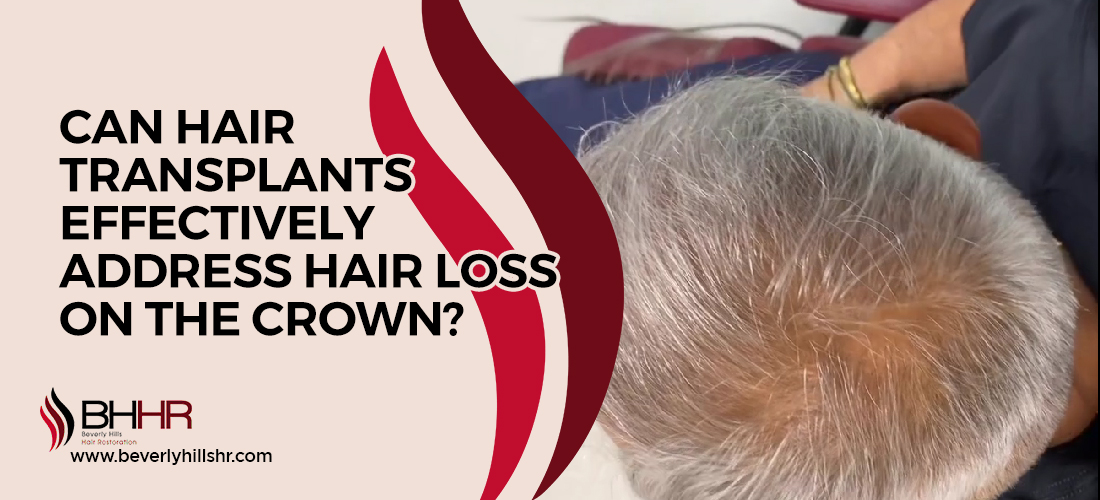
Can Hair Transplants Effectively Address Hair Loss on the Crown?
Home / Hair Transplant / Can Hair Transplants Effectively Address Hair Loss on the Crown?
Updated On : August 05, 2026 | Category : Hair Transplant | Author: Beverly Hills Hair Restoration Team
Quick Answer
Yes, a hair transplant can restore thinning or bald areas on the crown when enough healthy donor hair is available. Success depends on the crown’s size, hair-loss pattern, graft placement, and the technique used.
Introduction
A bald or thinning crown can become more noticeable over time, especially in photos, under bright lighting, or when styling your hair. This often leads to an important question: can a hair transplant restore the crown as effectively as the hairline? The answer is often yes, but crown restoration requires careful planning because the hair grows in a natural circular pattern rather than one straight direction.
The final result depends on several factors, including the size of the thinning area, the strength of the donor hair, the stage of hair loss, and the technique used. A successful crown transplant must also match the natural angle and direction of the surrounding hair. This guide explains how the procedure works, who may be a good candidate, what affects the outcome, and what you can realistically expect during recovery and growth.
Can a Hair Transplant Restore Crown Hair Loss?
Yes, it can. A crown hair transplant is one of the most effective ways to restore hair in the crown when performed on the right candidate. During the procedure, healthy hair follicles are taken from the back or sides of the scalp and transplanted into the thinning crown. These donor hairs are selected because they are generally more resistant to the type of hair loss that affects the crown.
Unlike the hairline, restoring the crown is not just about adding more hair. The transplanted follicles must follow the natural swirl of the crown so the new growth blends smoothly with the surrounding hair. This careful planning helps create balanced coverage instead of an artificial-looking result.
The final outcome depends on several factors, including:
-
The amount of healthy donor hair available
-
The size of the thinning or bald area
-
Your hair thickness and texture
-
Your current hair density
-
Your overall hair loss pattern
-
The technique used during the procedure
A crown hair transplant can improve the appearance of the scalp and create fuller-looking hair. However, the goal is to achieve natural coverage rather than recreate the exact hair density you had years ago. Setting realistic expectations is an important part of planning successful treatment.
Why Is the Crown More Difficult to Restore?
The crown is one of the most challenging areas of the scalp because the hair grows in a natural spiral, often called a whorl. Instead of growing forward like the hairline, the hair spreads outward in different directions from the center of the crown.
This means every transplanted follicle must be placed at the correct angle and direction. Even small changes in placement can affect how natural the final result looks once the hair grows.
Another challenge is the size of the crown. What appears to be a small bald spot can actually cover a large surface area, which may require more grafts than many people expect. At the same time, the surgeon must preserve enough donor hair for any future hair loss that may develop in other parts of the scalp.
Because of these factors, crown hair restoration requires careful planning, proper graft distribution, and an understanding of your long-term hair loss pattern. The goal is not simply to cover the area but to create hair that looks natural from every angle.
Who Is a Good Candidate for a Crown Hair Transplant?
Not everyone with crown hair loss needs a hair transplant. The best results are usually seen in people who have enough healthy donor hair and a hair loss pattern that has become more stable over time.
You may be a good candidate if you:
-
Have thinning or a bald spot on the crown
-
Have healthy hair on the back or sides of your scalp
-
Are in good overall health
-
Want a long-term solution for crown hair loss
-
Have realistic expectations about the results
During your consultation, the surgeon will examine your scalp, donor area, and hair loss pattern before recommending the most suitable treatment. This evaluation helps determine whether a crown hair transplant is the right option or if another approach may be more appropriate.
What Affects the Success of a Crown Hair Transplant?
A crown hair transplant is carefully planned for each patient. Several factors can influence how the final results look.
Donor Hair Quality
Healthy donor hair is one of the most important parts of a successful transplant. Strong donor follicles have a better chance of producing lasting growth after they are transplanted.
Hair Thickness and Texture
Thicker or curly hair often provides better visual coverage than fine, straight hair because it naturally covers more of the scalp.
Size of the Crown
A larger crown usually needs more grafts than a smaller thinning area. The surgeon must balance good coverage with preserving donor hair for the future.
Natural Hair Growth Pattern
The crown has a circular growth pattern. Matching this natural direction helps the transplanted hair blend smoothly with the surrounding hair.
Surgical Planning
Proper graft placement, spacing, and density all play an important role in creating a balanced and natural appearance.
Following Aftercare Instructions
The healing process is just as important as the procedure itself. Following your surgeon's aftercare instructions supports healthy recovery and gives the transplanted follicles the best chance to grow successfully.
Smart FUE vs. Smart FUT: Which Technique Is Better for the Crown?
Both Smart FUE and Smart FUT can restore hair on the crown. The right technique depends on your hair loss, donor hair, and the number of grafts needed, not simply which procedure is more popular.
|
Smart FUE |
Smart FUT |
|
Hair follicles are removed one by one. |
A thin strip of donor hair is removed before the follicles are prepared. |
|
Leaves tiny extraction marks in the donor area. |
Leaves a fine linear scar that is usually covered by surrounding hair. |
|
Often chosen by people who prefer shorter hairstyles. |
May be a good option when a larger number of grafts is needed. |
|
Recovery from the donor area is generally quicker. |
Recovery may take slightly longer because of the donor incision. |
Dr. John Kahen recommends the most suitable technique after evaluating your donor hair, crown size, and long-term restoration goals. The focus is always on achieving natural-looking coverage while protecting your donor hair for the future.
When Will You See Results?
Hair growth after a crown transplant takes time. The transplanted follicles need to heal before new hair begins to grow, so results appear gradually over several months.
|
Timeline |
What You Can Expect |
|
First 2 Weeks |
The scalp heals, and small scabs gradually disappear. |
|
2–8 Weeks |
Some transplanted hairs may shed. This is a normal part of the growth cycle. |
|
3–4 Months |
New hair begins to grow from the transplanted follicles. |
|
6–9 Months |
Hair becomes thicker, and the crown starts to look fuller. |
|
12 Months or Longer |
Most patients see their final results as the transplanted hair continues to mature. |
Because the crown often develops more slowly than the hairline, patience is important. Every person heals differently, so the timeline may vary depending on individual hair growth and recovery.
Why Choose Beverly Hills Hair Restoration for Crown Hair Transplants?
Crown hair restoration requires more than simply adding grafts to a thinning area. The natural swirl of the crown, the size of the bald spot, and the amount of donor hair available must all be carefully considered. At Beverly Hills Hair Restoration, each treatment is planned around the patient’s hair loss pattern, scalp condition, and long-term needs.
-
Detailed Crown Evaluation: The crown, donor area, hair density, and future hair loss pattern are reviewed before treatment.
-
Personalized Treatment Planning: Every procedure is designed around the patient’s scalp, donor supply, crown size, and restoration goals.
-
Smart FUE and Smart FUT Options: Dr. John Kahen evaluates which technique may be more suitable based on graft needs and donor availability.
-
Natural Whorl Design: Grafts are placed to follow the crown’s natural angle and circular growth pattern.
-
Long-Term Donor Management: The treatment plan considers both current crown thinning and possible future hair loss.
-
Clear Recovery Guidance: Patients receive support from consultation through healing and hair growth.
Conclusion
A crown hair transplant can effectively restore thinning or bald areas when there is enough healthy donor hair and the procedure is carefully planned. Since the crown has a unique circular hair growth pattern, natural-looking results depend on proper graft placement, the right technique, and a treatment plan based on your individual hair loss.
If you're considering a crown hair transplant, a detailed consultation is the best way to understand your treatment options and expected results. At Beverly Hills Hair Restoration, Dr. John Kahen evaluates your hair loss pattern, donor hair, and restoration goals to recommend a personalized treatment plan using advanced Smart FUE and Smart FUT techniques.
Call 310.289.0901 to schedule your free consultation with Dr. John Kahen and learn whether a crown hair transplant is the right solution for you.
Frequently Asked Questions
Can a crown hair transplant cover a completely bald crown?
It may be possible if enough healthy donor hair is available. The final coverage depends on the crown’s size, donor density, and the treatment plan.
Will I need more than one crown hair transplant?
Some patients may need a second procedure if the crown is large or they want more density. This depends on donor hair and individual goals.
Does hair texture affect crown hair transplant results?
Yes. Thick, curly, or wavy hair often creates better visual coverage than fine, straight hair.
How many grafts are usually needed for a crown hair transplant?
The number varies based on the size of the thinning area, donor density, hair thickness, and the level of coverage you want.
What happens if I continue losing hair after a crown transplant?
The transplanted hair may continue growing, but nearby natural hair can still thin. Future hair loss should be considered during treatment planning.